Sunday, 9 November 2014

Key performance Indicators of Software Developers– examples of kpi

Key performance Indicators of Software Developers– examples of kpi


In this post, you can ref free useful materials about examples of kpi and other materials for examples of kpi such as kpi tips, kpi mistakes, kpi examples, examples of kpi, kpi dashboard, kpi form, how to create kpi/performance metrics
If you need free ebook:

• List of free 2436 KPIs
• Top 28 performance appraisal forms
• 11 performance appraisal methods
• 1125 performance review phrases

please visit: kpi123.com

KPI guides


Measuring the effectiveness of your software developer(s) can be tricky (even if you have a perfect set of Key Performance Indicators). It’s a little like dealing with a serviceman where you put your trust in their abilities and knowledge, hoping that unnecessary replacement parts and labor time are not tacked on. So trust is an important factor, but not the only factor in this equation.

KPI Software Development Indicators

If you have already arrived at that point where you are beginning to question effectiveness … chances are it’s a sign something is wrong. The challenge is that the performance risk indicators that caught your attention may not necessarily be the direct fault of your software developer(s). There are many potential sources from which issues can appear in the development process … and all need to be understood and evaluated.
From my personal experience, I would have to say the single most problematic issue is the requirements not being clearly understood and communicated from the beginning. In years past as an independent contractor, I used to joke that a job posting would say one thing, the recruiter would explain it as another, the client would explain it as still another and (as you’ve probably already guessed) when I actually went to do the job … it turned out to be something different than any of the initial descriptions. Suffice it to say, in such cases productivity is sidelined while defining the work becomes the priority.

Software Development Qualifications

In a nutshell, effectiveness is a function of the software developer’s technical knowledge, practical experience, application exposure, and communication abilities. Within any particular venue, one software developer may be able to complete a task in one tenth the time of another. Yet in a different venue the positions of those same two technicians may be reversed. It is for this reason that I firmly believe a software development company is preferable to hiring individual software developer(to augment your staff). A good quality software development company should be experts at completing projects in the most effective way possible through clear communication and proper assignment of tasks based on skill.

Key Performance Indicator Evaluations

Evaluation of a software development program can also be tricky because so much is based on the knowledge of the individual doing those evaluations. For example, a code review is a perfectly acceptable way to determine if new code is documented and written in the same fashion as previous code. However, as obvious as this might sound, this evaluation method cannot be used by someone who isn’t familiar with coding.

Software Development Key Performance Indicators that may help

1. Is the overall attitude of the software developer positive? Does it seem like he (she) enjoys the job?
2. How quickly does he (she) grasp the requirements of a project and is then able to communicate it to others?
3. During the requirements gathering phase does the software developer ask probing questions to help identify true needs? If not, the scope of the project may change as development occurs.
4. Are the requirements thoroughly documented before development begins?
5. Does the software developer present a clear plan of how the process will proceed? Does this include an estimate of the number of hours the project will take and when it should be complete?
6. Is progress being demonstrated throughout every phase of the project?
7. Are the estimates for hours and delivery dates you were given being met? If not, then why not?
8. How many bugs are caught in testing? Why did these occur?
9. Do you review the progress of each project to determine if something could have been improved?
10. Does the application work the way you intended it? Are there subtle things wrong?


What is a Key Performance Indicator (KPI)
How to Develop Key Performance Indicators (KPIs)

Saturday, 8 November 2014

Top 5 KPIs to measure your online recruitment effectiveness– examples of kpi

Top 5 KPIs to measure your online recruitment effectiveness– examples of kpi


In this post, you can ref free useful materials about examples of kpi and other materials for examples of kpi such as kpi tips, kpi mistakes, kpi examples, examples of kpi, kpi dashboard, kpi form, how to create kpi/performance metrics
If you need free ebook:

• List of free 2436 KPIs
• Top 28 performance appraisal forms
• 11 performance appraisal methods
• 1125 performance review phrases

please visit: kpi123.com

KPI guides


The importance of recruiters measuring their Key Performance Indicators (KPIs) to ensure goals are being achieved is crucial to an organisation's performance as a whole.  Once certain quantifiable goals have been identified, keeping an eye on your KPIs will help you confirm whether or not the work being carried out is actually achieving those set targets.
Some examples of recruitment KPIs are:

Get Found - Having a fully functional recruitment website to be used as ‘the hub’ for all your candidate activities is critical. Maintaining visitors on your site and then progressing them through to perform an action such as registering or applying for a job should be the main purpose. There’s no point in investing in a cutting edge design if you don’t have specific calls to action or effective candidate journeys to encourage interaction at specific points throughout the site.
Potential ratio calculation: Number of unique users/Number of candidate registrations + applications 
Candidate Conversion – Of the number of candidates who applied online, who actually got considered by the hiring manager and placed? By measuring the quality of your applications against the number of those who progressed you can quickly see if what you’re doing is providing you with the required level of candidate.
Potential ratio calculation: Applications source/Placement

Candidate Engagement – Encourage your existing candidates to return to your website. You don’t have to be continually working on getting new visitors. By measuring the percentage of those returning and interacting you can see if improvements have to be made to your site’s content or functionality. Potential ratio calculation: Existing user visits/New job alerts + applications
Candidate Attraction - There are now loads of really useful free online tools which you can use to help market your vacancies to the largest audience possible. And don’t forget there are also a number of job boards which are either completely free or giving away free trials so take full advantage of these. The more job boards you post on, the greater the opportunity for you to attract the right candidate. And are your job adverts or titles so attractive that they're being shared? Don't forget, attractive adverts go a long way. 
Potential ratio calculation: Number of Re-tweets + Refer a friend/Applications 

Social reach: Social networks are being used to communicate with candidates, but they can also be used as an additional channel to advertise your vacancies. And best of all, at the basic level they're completely free. It’s no longer necessary to spend thousands on those big print ads. You do need to measure which channel is the most effective to ensure what you’re doing is giving you the best return though.
Potential ratio calculation: Unique users/Number of general registrations + applications
By using the above methods, you can quickly identify if there any blockages in your online efforts and discover where improvements can be made. Are candidates falling off at any stage of the process? If your adverts are getting lots of views but the percentage of applications is low, you know you have to work on improving your adverts. Or if there is a lot of candidate activity on your website but only a few registrations then you'll need to look at the registration process. Is it too long? Not clear enough? The quicker you're able to identify any issues and resolve them the better for everyone involved.


What is a Key Performance Indicator (KPI)
How to Develop Key Performance Indicators (KPIs)

Friday, 7 November 2014

Measuring Project Progress Key Indicators to Expect– examples of kpi

Measuring Project Progress  Key Indicators to Expect– examples of kpi


In this post, you can ref free useful materials about examples of kpi and other materials for examples of kpi such as kpi tips, kpi mistakes, kpi examples, examples of kpi, kpi dashboard, kpi form, how to create kpi/performance metrics
If you need free ebook:

• List of free 2436 KPIs
• Top 28 performance appraisal forms
• 11 performance appraisal methods
• 1125 performance review phrases

please visit: kpi123.com

KPI guides


Choosing Key Performance Indicators (KPIs) to track project progress is an important decision for a project manager. In this article, we’ll go over four key examples of KPIs, as well as tools and representations to measure the progress of your project.

Examples of KPIs to Measure Progress

 When an executive, project sponsor, PMO member or client wants to know how a project is going, they don’t want to read status reports or several pages of text that help describe what is going on. What they want are easy-to-understand metrics that answer the questions that they have, that will accurately paint the picture they need. In fact, when it comes down to it, there are really four things they want to know.
o    Are we on schedule?
o    Are we on budget?
o    How much is left to do?
o    How much have we already done?
There are many other examples of Key Performance Indicators that you can use; however, they will essentially roll up to one of these four topics. In fact, knowing the answer to each of these four questions should be enough for you to know if your project is red or green, in true stoplight fashion. Conversely, only knowing a few of these answers won’t be enough to tell you much at all. If you are on time, but over budget, then that’s not a good sign. Nor is the outlook optimistic if you can’t articulate what there is left to do or what you have already done.
You need an accurate and simple way to convey your project progress, as measured by these Key Performance Indicators, to anyone who needs to know the answer. In order to be useful, they need to be easy to understand while conveying the information necessary. Let’s look at two examples of communication tools--that can be used in conjunction--to deliver all four of these factors to project stakeholders.

Burn-Down charts as an Example of a KPI Communication Tool

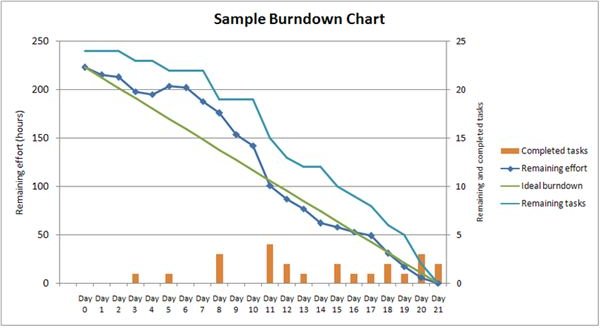
 The burn-down chart is a tool that is often associated with the Scrum methodology. On the X-Axis of the chart (click on the image) is time. This can be project time, iteration time, or some other unit of time that the project team is used to dealing with. On the Y-Axis is the outstanding work, usually known as the backlog. See the picture for an example of what a burn-down chart looks like.
The purpose of this chart is to show how much work is remaining. There are three main inputs: the planned work complete, the planned work remaining, and the actual work remaining. When the project manager makes the project plan, he plans each iteration or unit of time with an idea for how much work is going to get done in each unit. As time passes, the completed work grows, and the remaining work shrinks. A line can then be drawn that shows the actual work remaining. If the amount of work remaining to do is above the line, then you should quickly be able to determine that you are behind schedule. If you are below the line, then you are ahead of schedule.
With this kind of KPI to use as an example, you can quickly communicate project schedule status. With this kind of obvious visual aid, you can tell early on if you are behind. Many projects find themselves unexpectedly behind later in the project, because they lacked a good way to track progress along the way. Using a burn-down chart as a key performance measure, you can often tell very early on in the project if you need to figure out where to make up time.
Please turn to page 2 for more examples of key performance indicators
The best examples of Key Performance Indicators (KPIs) convey a lot of information to project stakeholders at a glance. Choosing the right ones can greatly help your project track progress. Project stakeholders are often asking for a quick way to know how a project is doing. They want to know how the schedule is, how the budget is shaping up, and if the delivery will be on time. Among a wide array of other things. Using some of these examples of key performance indicators, you can convey all the necessary information all at once, and greatly reduce questions and need for more reporting.

Earned-Value Charting as a Key Performance Indicator

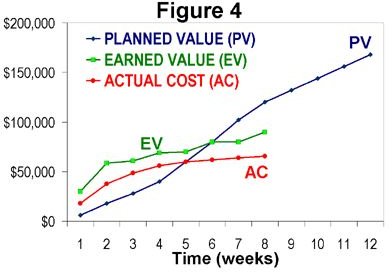
 Earned-Value charts look similar to burn-down charts, but they are actually quite different. They are a way to measure adherence to schedule, budget and project scope, all at the same time. Rather than burning down, an earned-value chart trends up as the project progresses. It measures value planned, value created, cost expended, and elapsed time, all in one chart. With three simple lines on a graph, you can tell virtually all of the KPIs mentioned on page 1.
See the picture to the left for an example of what an earned value chart looks like. As you can see, the blue line represents how much value the project is supposed to have created compared to the time elapsed. Value can either mean something like functionality built, or tasks complete, or even literal sales made. Whatever your project team decides to use as value, this chart will help graph it.
The green line represents how much value has actually been created, using the same metrics. If the green line is below the blue line, then you are behind schedule. If it is above, then you are ahead of schedule. It is very possible to flow back and forth from being behind to being ahead, and back again. The red line represents cost. If the cost is below the blue line, then you are under budget, if above, you have spent more than allotted to the budget.
When you put all four dimensions together, planned value created, actual value created, cost and time, you can get a very powerful and very simple view of how your project is doing.

Project Progress Key Performance Indicators

There are many examples of key performance indicators for project performance. However, they all break down into cost, schedule, work remaining and work complete. A project that overcomplicates how they are measuring progress, or fails to measure progress at all, can easily go astray, and the PM will not know it until it is too late. Using either a burn-down chart, or an earned value chart, you can easily tell at a glance how you are doing. Being able to communicate to all project stakeholders has incredible power, and you will instill confidence in the project, no matter the outcome.


What is a Key Performance Indicator (KPI)
How to Develop Key Performance Indicators (KPIs)